Nurotech
SEO
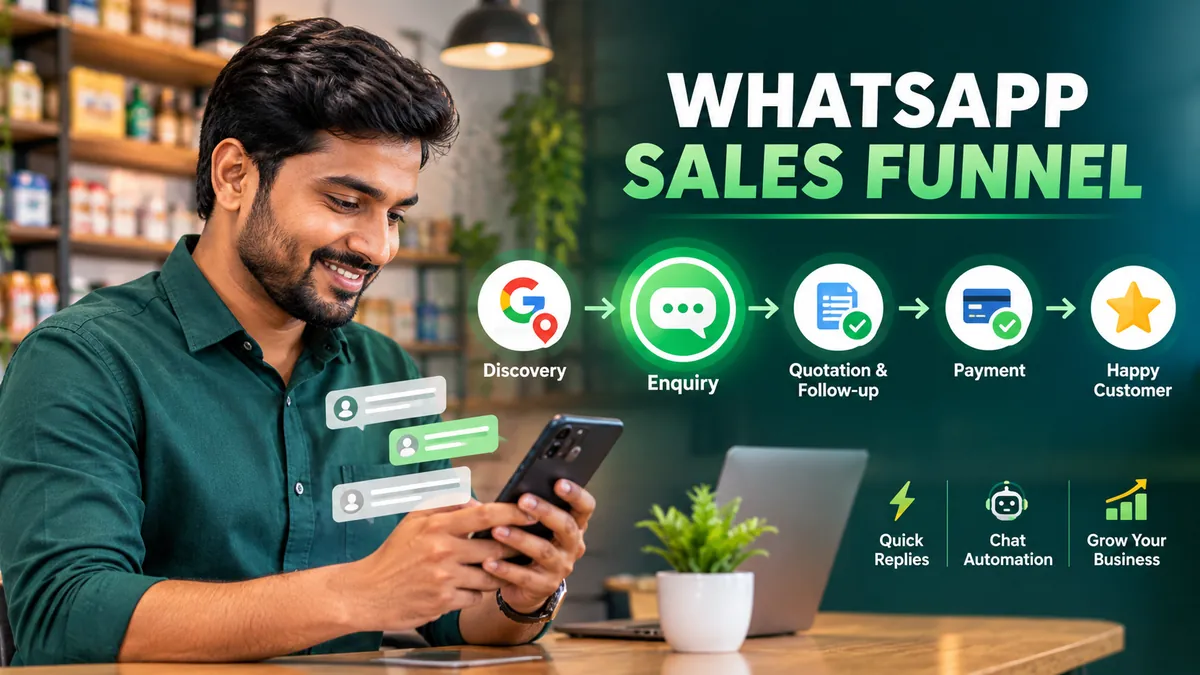
Most articles on the sales funnel describe a software company in California. A visitor reads a blog post, downloads an e-book, gets six nurture emails, books a demo and signs a contract. That model is real, but it is not how a dental clinic in Rohini, a modular kitchen showroom in Noida or a CA firm in Laxmi Nagar wins customers. Their funnel has the same top and bottom as the textbook version, but the middle is different: it happens on WhatsApp, it happens fast, and it is where most of their leads quietly die.
This guide draws that funnel stage by stage. It shows where enquiries leak, how to count them without buying a CRM, and where automation earns its keep. The short version: if you fix only one thing this month, fix how quickly and how consistently you reply on WhatsApp after someone asks for a price.
A sales funnel is the path a stranger takes to become a paying customer, drawn as a funnel because fewer people survive each step. Many people see you, fewer enquire, fewer still get a quote, and a small share buy, and the idea behind that picture is old. The AIDA model (Attention, Interest, Desire, Action) is usually credited to the American advertising pioneer E. St. Elmo Lewis around 1898, according to the history of the AIDA model. Modern versions rename the stages as awareness, consideration, decision and retention. The labels matter less than the habit behind them: you count how many people sit at each step, and you work on the step that loses the most.
The "sales funnel meaning" most people search for stops there. For an owner, the useful meaning is narrower: a funnel is a list of handoffs. Every handoff, from ad to call, call to quote, quote to payment, is a place where a lead can drop. Your job is to find the leakiest handoff and plug it.
The funnels described by Salesforce, IBM and most US marketing blogs assume three things. They assume the buyer researches alone for weeks. They assume email is the main follow-up channel. And they assume a sales team logs every touch in a CRM. Per the IBM overview of the sales funnel, the stages are tracked through tools that score and route leads automatically. That works when a deal is worth lakhs and the cycle runs 3 to 6 months.
A small Indian business usually sees the opposite pattern:
That last point changes the whole shape. In a US SaaS funnel, the slow middle is a feature. Nurture emails build trust over 30 or 60 days. In a local Indian funnel, the slow middle is a leak. If you reply 5 hours late, the buyer has already sent a deposit to someone else.
So the funnel worth drawing looks like this: search, Maps or an ad, then a call or a WhatsApp message, then a quote, then follow-up on WhatsApp, then the sale and the review. Four stages. Let's walk them.
The top of the funnel is where most owners spend their money and most of their attention. It covers Google search, Google Maps, Instagram and Facebook ads, JustDial-style listings and word of mouth.
Three channels do the heavy lifting for local businesses. The first is the Google Business Profile, which puts you in the Maps pack for "near me" searches, and the second is paid search and paid social, which buy attention on demand. The third is referrals, which are free and often the warmest leads you will get, but which cannot be switched on when you need more enquiries next week.
The one thing to get right here is the exit. Every top-of-funnel asset should hand the visitor straight to a conversation. That means a click-to-WhatsApp button on your site, a WhatsApp link on your Business Profile, and click-to-WhatsApp ads rather than ads that send people to a slow contact form. A form that emails you, which you check at 9 pm, adds a 10-hour gap before the funnel has even started.
When we audit local accounts, the most common Stage 1 problem is not traffic. It is a site that gets clicks and then asks the visitor to fill a 7-field form. Nobody in a hurry does that. If you are running ads, our performance marketing work in Delhi starts with the landing step for exactly this reason: a cheaper click is worthless if the next screen loses the lead.
Instagram is a special case. Reels can bring huge reach, but views are not enquiries. We wrote a separate piece on turning Instagram reels into WhatsApp enquiries because so many owners measure this stage by likes. Likes are not a funnel stage, but a message in your inbox is.
Count only the actions that start a conversation: calls from Maps, WhatsApp clicks from the site, WhatsApp clicks from ads, and form fills. Google Business Profile shows calls and website clicks for each month. Meta Ads Manager shows conversations started for click-to-WhatsApp ads. Add these up once a week. That number is the mouth of your funnel.
This is the stage the textbook skips. For most small businesses in India, the first real contact is a WhatsApp message like "Hi, price?" or "Do you do home visits in Dwarka?" It arrives at 11:40 pm, during a client meeting, or on a Sunday.
Two facts about this stage drive almost everything else in the funnel.
First, speed wins. The buyer has messaged several businesses. The one that replies with something useful in the first few minutes gets the conversation. A reply after 4 or 5 hours is often a reply to someone who has moved on.
Second, the first reply sets the tone for the whole sale. "Please call" pushes work back onto the buyer. A reply that answers the question, gives a price range and asks one sharp follow-up question keeps them moving.
WhatsApp also has a rule that shapes this stage. According to Meta's documentation for the WhatsApp Business Platform, once a customer messages you, a 24-hour customer service window opens. Inside that window you can reply freely. Outside it, you can only start a conversation with a pre-approved template message. In plain terms: the first 24 hours after an enquiry are your cheapest and easiest time to move the lead forward. If you miss them, re-opening the chat gets harder and, on the API, costs money.
In our experience, a strong first reply has four parts and fits on one phone screen:
That is it: no PDF brochure as the first message, and no 12-option menu. A menu-heavy bot that makes someone press 1, then 4, then 2 before they get a price is a leak dressed up as automation.
This is the stage where a WhatsApp chatbot for business does its best work. A bot does not need to close the sale. It needs to do the first reply well, every time, at any hour: greet, answer the common question, ask the qualifying question, and hand the chat to a human with the context filled in. Our team builds these flows so the owner wakes up to a list of qualified enquiries instead of a pile of "Hi, price?" messages from last night.
If Stage 2 is where leads are won, Stage 3 is where they are lost in bulk. The buyer has asked, you have replied, you have sent a quote. Then nothing happens.
We've seen this pattern across almost every local account we look at. Owners put real effort into the quote, send it, and then wait. They feel that following up is pushy. The buyer, meanwhile, has 3 other quotes, a busy week and no reason to come back. After about 48 hours without contact, the chat sinks below a dozen newer conversations on their phone. Out of sight is out of the funnel.
Here is a follow-up rhythm that works without being annoying:
That is four touches across 10 days, and each one adds something or asks something without begging. The last message matters more than it looks. It gives the buyer permission to say no, and a surprising share of people reply to it with "Sorry, was busy, let's go ahead."
The hardest part is not writing these messages. It is remembering to send them across 40 open quotes while also running the business. That is exactly where automation pays off, and we cover the details in our post on WhatsApp marketing automation for small businesses. A simple tag ("quote sent", "visit booked", "won", "lost") plus a scheduled reminder turns a memory problem into a list.
Silence after a quote is often a price objection the buyer did not want to say out loud. A follow-up that offers options gives them a way back in. "If the budget is tight, we can do the same layout in laminate instead of acrylic, which brings it down by about ₹40,000." That message turns a silent no into a conversation.
The bottom of the funnel has two jobs, and most small businesses only do the first.
The first job is the close. Make paying easy for the buyer. Share a UPI ID or payment link in the chat, confirm the date and the scope in writing, and send a short "here's what happens next" message. Every extra step, like "come to the office to pay the advance", gives the buyer a moment to reconsider.
The second job is the review. This is where the funnel bends back into itself. A Google review written in the buyer's own words feeds Stage 1 for the next 100 customers. It improves your Maps ranking and it answers the questions new buyers are too shy to ask.
Ask for the review on WhatsApp, at the moment the customer is happiest. For a service business that is usually right after the job is finished. For a product business it is 3 to 7 days after delivery. Send the direct review link, not "please review us on Google". One tap is the difference between a review and a good intention.
A small trick that helps: suggest what to mention. "If you have a minute, it really helps us when people mention the area and the service, like 'kitchen renovation in Pitampura'." Reviews that name a service and a locality carry more weight with future buyers than "good work, thanks".
You do not need software to run a funnel. You need a counting habit. Here is a simple methodology that takes about 20 minutes a week and works with a free Google Sheet.
Make a sheet with one row per enquiry and these columns: date, source (Maps, ad, site, referral, Instagram), first reply time in minutes, quote sent (yes or no), number of follow-ups, outcome (won, lost, open) and value in rupees. WhatsApp Business already lets you label chats. Use the same 5 labels as your sheet so the two match.
At the end of each week, work out four numbers:
Now a worked example, with made-up round numbers so the arithmetic is easy to follow. Say a business gets 120 enquiries in a month. It sends quotes to 60 of them, which is a 50% enquiry-to-quote rate. It closes 12, which is a 20% quote-to-sale rate. Average order value is ₹25,000, so the month brings in ₹3,00,000.
Which stage is worth fixing? If faster first replies lift the quote rate from 50% to 60%, that is 72 quotes instead of 60. At the same 20% close rate, that is about 14 sales, or ₹3,50,000. If better follow-up lifts the close rate from 20% to 25% on the original 60 quotes, that is 15 sales, or ₹3,75,000. Do both and you get 72 quotes at 25%, which is 18 sales and ₹4,50,000. The ad budget and the top of the funnel did not change at all, so the extra ₹1,50,000 came entirely from the middle.
That is the case for working on the middle before spending more on ads. Buying more traffic into a leaky funnel just buys more leaks.
People often ask what a good conversion rate is at each stage. The honest answer is that it depends on the trade, the price and the season. A ₹500 salon booking and a ₹5,00,000 interior project will never share a benchmark. Industry averages quoted by US software vendors describe US software buyers. Your best benchmark is your own sheet from last month. Track 8 to 12 weeks, find your normal range, and judge changes against that.
Automation on WhatsApp is powerful, and it is easy to overdo. The line is simple. Automation should remove waiting for the buyer and remove remembering for you. It should never add steps for the buyer.
Good uses of automation:
Uses that annoy buyers and hurt the funnel:
There is a legal side too. India's Digital Personal Data Protection Act, 2023 sets out how businesses must handle personal data, including consent and the right to withdraw it. Keep your messaging list to people who contacted you or agreed to hear from you, give an easy way to opt out, and do not buy number lists. For SMS, the separate TRAI rules under the Telecom Commercial Communications Customer Preference Regulations, 2018 already require registration on the DLT platform, as described on the TRAI website. A clean, consented list is better for compliance and better for reply rates.
Read every automated message aloud as if you were the buyer, standing in a shop, on your phone, slightly impatient. If any message makes you sigh, cut it or rewrite it. When we build flows for clients, we test them this way before they go live, and we usually remove a third of the steps we first planned.
The four stages look the same on paper. In practice, each trade bends them a little. Here are three common shapes, written as typical patterns rather than any one client's story.
Most enquiries start on Google Maps with a search like "dentist near me" or "physiotherapist in Vasant Kunj". The buyer is often in pain or worried, so Stage 2 is short and urgent. The questions are predictable: fees, timings, whether a doctor is available today, and whether the clinic is close by. A good first reply gives the consultation fee, the next 2 or 3 open slots and the Maps pin. The quote stage barely exists for a first visit. It shows up later, for treatment plans like a root canal or a 10-session physio course, where the patient goes home to think. That is where the follow-up rhythm matters. The review ask fits naturally after the final session, not the first.
Here the funnel is long and the ticket is large, often several lakh rupees. Leads come from Instagram, Google ads and site visitors who saw a finished kitchen in a friend's flat. The first conversation is about budget and timeline. The quote needs a site visit, so Stage 3 has two steps: book the visit, then send the quote. Each step can leak. The biggest risk is the gap between the visit and the quote. If the design and price take 6 or 7 days to reach the buyer, a competitor who sent theirs in 2 days has already won the trust. Showrooms that send a rough range on the same day and the full quote within 72 hours lose far fewer leads at this point.
Enquiries are seasonal and spike around filing deadlines, such as the 31 July due date for most individual income tax returns. Buyers ask "how much for ITR filing?" and compare 3 or 4 firms on price and trust. Stage 2 must handle volume, because 50 messages can land in a single evening in July. That is a strong case for an automated first reply that lists fixed fees for common cases and collects the documents checklist. Stage 4 is unusual here: the right moment to ask for a review is when the refund lands or the filing is confirmed, which may be weeks after payment. The real prize is retention. A client filed this year is the easiest sale next year, so the funnel loops back into a reminder 11 months later.
Notice what all three share: the top differs by channel and the bottom differs by timing. The middle is always a chat, and it always rewards speed and steady follow-up.
Some owners ask whether they should push buyers to call instead of chat. A call feels warmer and closes faster. The trouble is that calls only work when someone can pick up. A missed call at 8 pm is a lead with no context and no record. A WhatsApp message waits for you, carries the question in writing and lets you reply with photos, a location pin or a price list.
The practical answer is to offer both and let the buyer choose, but treat WhatsApp as the record. If someone calls, send a short WhatsApp right after: "Thanks for calling. As discussed, here is the price for 2 rooms and our address." Now the call has a written trail, the buyer has your number saved, and you have a chat to follow up in. Every lead, whatever channel it came from, ends up in the same place, which is what makes the counting habit possible.
In a big company, marketing owns the top and sales owns the bottom. In a 5-person business, that split rarely exists, and the funnel falls into the gap. The owner runs ads, the receptionist answers WhatsApp, a technician gives quotes on site, and nobody owns follow-up.
Give one person ownership of the middle. Their job is simple to describe: every enquiry gets a reply within a set time, every quote gets the follow-up rhythm, and every closed job gets a review request. They update the sheet daily. They do not have to do all the work themselves. They just have to make sure nothing sits untouched for more than 24 hours.
Pay attention to how you hand over between people. "Sir will call you" is a common message that often leads to nothing, because sir is busy. If the owner must handle pricing, set a rule: the receptionist tells the buyer when the owner will reply ("by 6 pm today"), and the owner keeps that promise. A specific time is a commitment. A vague "soon" is where leads go to wait and then leave.
One more habit helps a lot: a 10-minute review every Monday. Open the sheet, look at last week's four numbers, and pick one stage to improve. Over a quarter, that is 12 small fixes. Small teams that do this tend to outgrow competitors who only add ad budget, because every rupee of traffic they buy has fewer holes to fall through.
Some funnel fixes feel productive but change very little, and it helps to know them before you spend a month on one. The most common is redesigning the website when the real leak is a reply that arrives the next morning. A new site can lift the number of enquiries a little, but if half of those enquiries still wait 6 hours for an answer, the extra traffic simply drains out of Stage 2 the same way the old traffic did.
A second trap is buying a full CRM before anyone has the habit of logging leads. Software does not create discipline on its own, and a ₹2,000-a-month tool that nobody opens is a more expensive version of the empty Google Sheet. Run the free sheet for 8 weeks first; if the team fills it in every day, you will know exactly which features you need, and if they do not, a paid tool would not have fixed that.
The third trap is chasing a higher close rate by dropping prices across the board. Discounts can lift Stage 4 for a while, but they also cut margin on the buyers who would have paid full price anyway, and they rarely fix the silence after a quote, which is usually about timing and follow-up rather than the number on the page. Fix speed and follow-up first, then look at pricing with a few months of clean data in front of you.
Finally, watch out for measuring the wrong thing at the top. Impressions, reach and video views are easy to grow and nice to report, but they sit outside the funnel until someone starts a conversation with you. Keep your weekly review focused on the four numbers from the sheet, because those are the ones that move revenue.
Here is the whole funnel on one page, with the leak and the fix for each stage:
Look at that list and notice where WhatsApp sits. It touches every stage, but it carries the middle two almost alone. That is the WhatsApp-shaped middle in the title. The top of an Indian small business funnel looks like anyone else's. The bottom does too. The middle is a chat window, and how you run that chat window decides how much of your marketing spend turns into revenue.
Start small, because a funnel you actually track beats a perfect one you never set up. This week, add the enquiry sheet and track reply time. Next week, write your four follow-up messages and save them as quick replies in WhatsApp Business. In a month, you will know exactly which stage leaks most, and whether a chatbot or a simple reminder system is the right fix.
If you want help building the WhatsApp side of your funnel, from the first auto-reply to quote reminders and review requests, Nurotech can set it up around how your business already sells. Start with our WhatsApp chatbot service, or get in touch and tell us where your leads are getting stuck.
FAQs
Fill out the form or call us — let’s find where your next growth comes from.
9659 634 634 [email protected]Free Growth Audit
See exactly where your traffic, leads and ROAS are leaking — and how to fix it. A senior Nurotech strategist reviews your website, SEO and ads. Free, no obligation.
No spam. We reply within 1 business day.