
Web Design
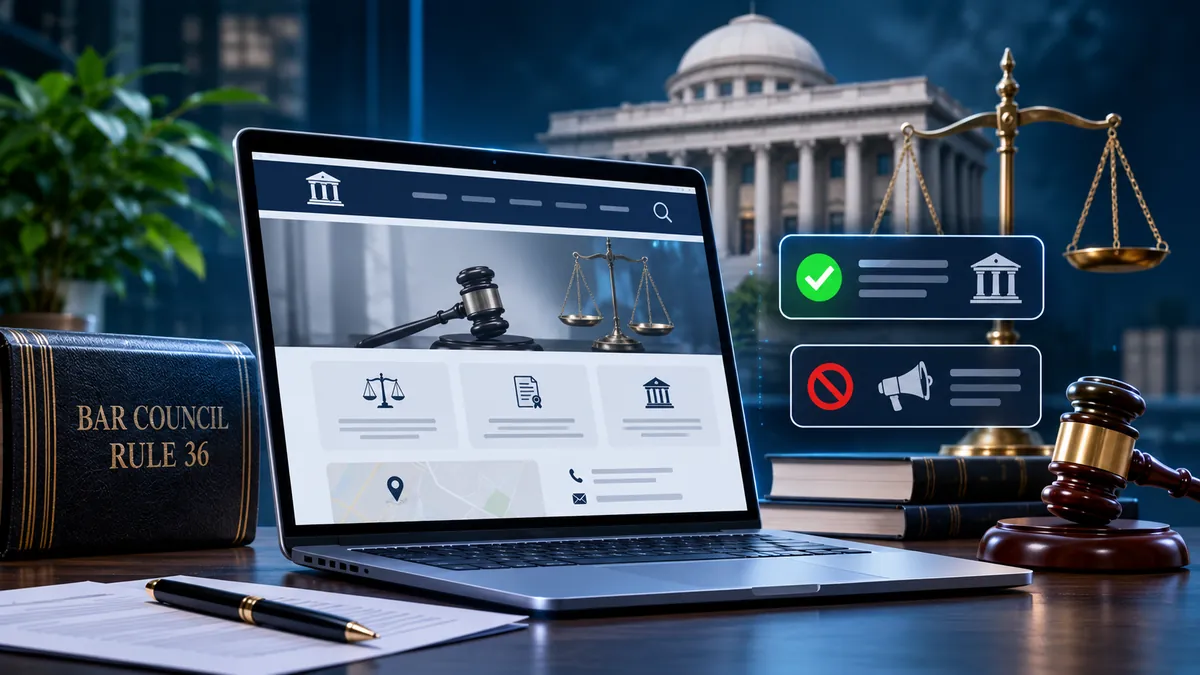
Search "law firm SEO" and the first page is almost all American advice. Build a practice-area page for every city. Collect fifty reviews. Bid on "best divorce lawyer near me." Run a case-results page with dollar figures. Every one of those tactics assumes lawyers are allowed to advertise. In India, they mostly aren't. Rule 36 of the Bar Council of India Rules says an advocate shall not solicit work or advertise, directly or indirectly. An advocate in Delhi who copies a US playbook doesn't just waste budget. They hand a complaint to the Bar Council of Delhi.
So what's left? More than most people think. A chamber or firm can still be found, still be trusted, and still get enquiries from people who are already looking for help. The route is information, not promotion. This guide walks through what Rule 36 says, what the permitted website information looks like, how to set up a Google Business Profile that stays on the right side of it, which content works, and a checklist to run before anything goes live. Nurotech, the digital agency behind this site, writes it from the marketing side. It isn't legal advice, and the compliance section needs a check by a practising advocate before you act on it.
The three pages that rank first for this topic in Delhi, from Shrey Webs, Invedus and AgencyAnalytics, are competent SEO guides. They explain practice-area pages, local citations, link building and review generation well. The gap is that they treat a law firm like any other local service business. In the United States, state bars permit advertising with disclaimers. In India, the profession is regulated differently, and the regulator's default position is that legal practice isn't a trade.
That changes the SEO plan in five concrete ways.
What survives is the part of SEO that was never about persuasion: a technically sound site, accurate information, clear structure, and content that answers real legal questions. That's a smaller toolbox. It's also a less crowded one. Keyword research run for this post on 10 November 2026 puts "law firm seo" at roughly 40 searches a month in Delhi and 720 across India, with a keyword difficulty of 26 out of 100. The searches are mostly advocates and firm managers looking for a vendor. The clients those advocates actually want ask a different set of questions, and we'll get to them.
Rule 36 sits in Part VI, Chapter II of the Bar Council of India Rules, the chapter on standards of professional conduct. The rulebook is published on the Bar Council of India website, and that's the text to read before you rely on any summary, including this one. Quote it from the source, not from a blog.
Here's the operative language as the Madras High Court set it out in Mr. P.N. Vignesh v. The Chairman and Members of the Bar Council of India (W.P. No. 31281 of 2019, decided 3 July 2024). According to the court, the Rules "clearly prohibit advocates from advertising or soliciting work directly or indirectly whether by circulars, advertisements, touts, personal communication, interviews not warranted by personal relations, furnishing or inspiring newspaper comments or producing his photographs to be published in connection with case where he is engaged or concerned." The court added that the only proviso is that advocates can furnish website information as prescribed in the Schedule, under intimation to and as approved by the Bar Council of India. You can read the full order on Indian Kanoon, and the court's own copy sits on the Madras High Court judgments portal.
Three things stand out for anyone doing SEO.
First, the word "indirectly." It's broad on purpose. A rule that only banned direct advertising would be easy to dodge with a sponsored article or a ghost-written newspaper comment. Rule 36 closes that door, and it means an agency can't launder promotion through a third party and call it content marketing.
Second, the website proviso. Rule 36 doesn't say advocates can't have a website. It says the information on one has to fit what the Schedule prescribes. So the site itself is lawful. What goes on it is the issue.
Third, the consequence. The Madras High Court noted that non-compliance with Rule 36 invites Section 35 of the Advocates Act, 1961, which deals with punishment for professional misconduct. Complaints go to the State Bar Council. For a Delhi chamber, that means the Bar Council of Delhi. A marketing plan is a bad reason to be explaining yourself to a disciplinary committee.
The Schedule to Rule 36 lists the website information an advocate may furnish. Read the current Schedule itself, and ask the Bar Council of Delhi if anything is unclear, because the details have been revised over the years and this guide can't promise it matches the latest version. In general terms, the permitted material is identity and contact information, enrolment details, qualifications and areas of practice. Think of it as the information on a visiting card, put online. The site is a directory entry that happens to be well built.
A workable page inventory for a Delhi advocate or firm looks like this:
What doesn't belong: "Why choose us," "Our success rate," client testimonials, awards copy that reads as a boast, rankings from third-party "top lawyer" lists, photos from a case, fee offers, and any call to action that reads as "hire us today." A neutral "Contact" page is information. A banner saying "Free first consultation" is solicitation.
One edge case comes up constantly. Is a contact form allowed? A form is a way for someone to reach a person whose details are already public. A phone number is the same thing in a different shape. The risk sits in the wording around it, not in the form. "Send us your query" is fine. "Get a callback in 10 minutes" starts to sound like a sales funnel, and a funnel is exactly what the rule is aimed at. If in doubt, the safest copy is the least exciting copy.
Most of the agency tactics in the top-ranking guides fail Rule 36 in a specific way.
Review generation. The US guides tell lawyers to ask every happy client for a Google review. Rule 36 bars soliciting work and also "inspiring newspaper comments." Whether a review request is covered isn't something this guide can settle for you, and the rules don't mention Google reviews at all. The cautious reading is that actively asking clients to publicly praise an advocate sits close to promotion. A Bar Council of Delhi view or an advocate's own senior counsel is the right place to get an answer. Until you have one, don't run a review campaign, and never display testimonials on the site.
Directories and rating sites. In the 2024 Madras High Court case above, the court found that online platforms that charge lawyers to be listed and connect them with litigants were doing something Rule 36 treats as touting. The court issued directions asking the Bar Council of India to circulate guidance to State Bar Councils. The practical lesson: a paid "premium listing" on a lawyer-matching site isn't a neutral citation. Check the platform's model before signing up.
Paid ads. Rule 36 doesn't carve out an exception for Google Ads. An ad is advertising in the plain meaning of the word. Google also has its own policies for legal services ads, in its advertising policy centre, but a platform allowing something doesn't make it permissible under Bar Council rules. For an advocate, the Bar Council rule wins.
Case results. "We won 312 cases" and "₹4 crore recovered" are the kind of numbers US agencies love. In India they read as an advertisement for outcomes. Skip them. Describing a legal principle that came out of a reported, public judgment is different, and it's ordinary legal writing.
Superlatives. "Top," "leading" and "number one" are claims that can't be verified. They're also one of the most common patterns on law-firm sites copied from other industries. Remove them.
A Google Business Profile (GBP) is where a chamber's address and phone number show up on Google Maps. It's the most useful local asset available, and it can be set up in a way that mirrors the visiting-card logic of the Schedule.
Fill in only facts:
Leave out GBP posts that read as promotions, offers and "book now" buttons. If the profile has a question-and-answer section, check it regularly: anyone can post in it, and a stranger's question that implies a result ("Can you win my case?") shouldn't be answered with a promise. Reviews are the hard part. People can leave them without being asked, and you can't stop that. How an advocate responds, or whether they respond at all, is another judgment call to put to the Bar Council. A reply that says "thank you" in a courteous tone differs from a reply that restates a case outcome, which would also raise client confidentiality problems.
The same discipline applies to every other listing. The name, address and phone number must match across the website, GBP, Bar Council records and any directory entry that's actually permitted. Local SEO calls this NAP consistency. Here it's also just accuracy. For the mechanics of setting up and maintaining a profile, Nurotech's local SEO services page covers the general process, and the same logic is applied to a multi-branch setup in this Google Business Profile guide for Ghaziabad and East Delhi.
Here's the part that works. Most people searching for legal help don't search for a lawyer first. They search for their problem. "How long does a cheque bounce case take." "Is a registered will enough for property transfer." "Can I file for divorce in Delhi if my spouse lives in another city." Those searches have lots of volume and little rank-worthy competition, because most of what ranks is a thin article from a directory. An advocate can answer them honestly, with the tone of a textbook rather than a sales page. That's information, and information is what the Schedule is designed to allow.
A few rules keep an explainer on the right side:
Law is a "Your Money or Your Life" topic in Google's terms. Its quality rater guidelines put extra weight on experience, expertise and trust for pages where bad information can hurt someone's finances or legal position. For an advocate, that's an advantage. The author is exactly the sort of qualified person the guidelines describe, and the content needs to show it through accurate citations, not through adjectives.
Structured data can describe the chamber without adding a single promotional claim. The LegalService type from schema.org takes name, address, phone and opening hours. Here's a minimal pattern with placeholder values to replace with the real ones:
<script type="application/ld+json">
{
  "@context": "https://schema.org",
  "@type": "LegalService",
  "name": "Registered name of the advocate or firm",
  "url": "https://example.com/",
  "telephone": "+91-00000-00000",
  "address": {
    "@type": "PostalAddress",
    "streetAddress": "Chamber number, court complex",
    "addressLocality": "New Delhi",
    "postalCode": "110000",
    "addressCountry": "IN"
  },
  "openingHours": "Mo-Sa 10:00-18:00"
}
</script>
There's no aggregateRating and no review property in it, on purpose. Adding rating markup to a lawyer's page would put a promotional signal into the page's code, so leave it out.
Local intent in legal search is real, but it's narrower than in restaurants or salons. A litigant in Karkardooma wants a chamber they can physically reach, or at least one whose address makes sense for the court where the matter is listed. That favours three things.
One page per genuine location. If a firm has chambers at two court complexes, each gets a contact page with its own address, map and hours. Don't create twenty "lawyer in [area]" pages for places the advocate has no office in. They're thin, they're doorway pages by Google's definition, and they read as soliciting in every neighbourhood.
Court-aware content. An explainer that says "Family matters in Delhi are heard at the family courts attached to the district court complexes" is useful and local. It names a real place, and it helps a stranger understand where to go. Nothing in it asks them to hire anyone. The same format works for property, consumer, cheque-bounce and tenancy matters.
Technical basics done well. Mobile speed matters because many searches happen on a phone while a person is standing outside a court. Aim for pages that load in under 3 seconds on a mid-range Android device. Use a clear title tag under 60 characters, one H1, descriptive headings and a readable text size. Delhi-based agencies, including the work covered on Nurotech's SEO company in Delhi page, run the same technical checks for any site. What changes for an advocate is only what you're allowed to say once the page loads.
For a sense of how another regulated profession handles the same tension, the clinic version is covered in this guide to marketing a clinic in Delhi NCR without breaking the NMC code. The shape of the problem is the same. A regulator limits promotion, and the practices that grow are the ones that turn factual accuracy into the thing people trust.
A compact list of the things most likely to cause trouble, in rough order of risk:
The reasoning behind this list isn't only legal. The Madras High Court's 2024 order explains the policy: paid visibility favours advocates with money, and the court called the legal profession "not a commercial activity." Agencies that understand that don't treat Rule 36 as an obstacle. They treat it as the brief.
What does it cost to get this wrong? There are no published tariffs, and the outcome depends on the complaint, the State Bar Council and the facts. What's certain is that Section 35 of the Advocates Act, 1961 gives the State Bar Council power to act on a complaint of professional misconduct. A 4-week blog calendar isn't worth a disciplinary reference.
Expect slower than a retail site, because there are fewer levers. Without ads, reviews or directory links, growth comes from content depth and accurate local data. A realistic timeline for a new chamber site:
Those are planning ranges, not promises. No one can guarantee a ranking, and an agency that promises "page one in 30 days" for a legal keyword is making the sort of claim the profession itself wouldn't allow. Track the right measures: impressions and clicks for informational queries in Google Search Console, calls and direction requests on the Business Profile, and enquiries that came through the contact page.
Run this before any page, listing or post goes live. Print it, tick it, and keep the signed-off version.
Methodology note: this guide draws on the text of the Madras High Court's 3 July 2024 order, the published structure of the Bar Council of India Rules, and the three page-one articles linked above. It doesn't draw on any Bar Council of Delhi interpretation or private legal opinion, which is why the reviewing-advocate step is on the list. If you're an advocate who'd like the technical side of this handled, whether that's the site build, structured data or Business Profile set-up, get in touch through the Nurotech local SEO services page. The compliance calls stay with you and your Bar Council.
FAQs

Fill out the form or call us — let’s find where your next growth comes from.
9659 634 634 [email protected]Free Growth Audit
See exactly where your traffic, leads and ROAS are leaking — and how to fix it. A senior Nurotech strategist reviews your website, SEO and ads. Free, no obligation.
No spam. We reply within 1 business day.