Nurotech
SEO
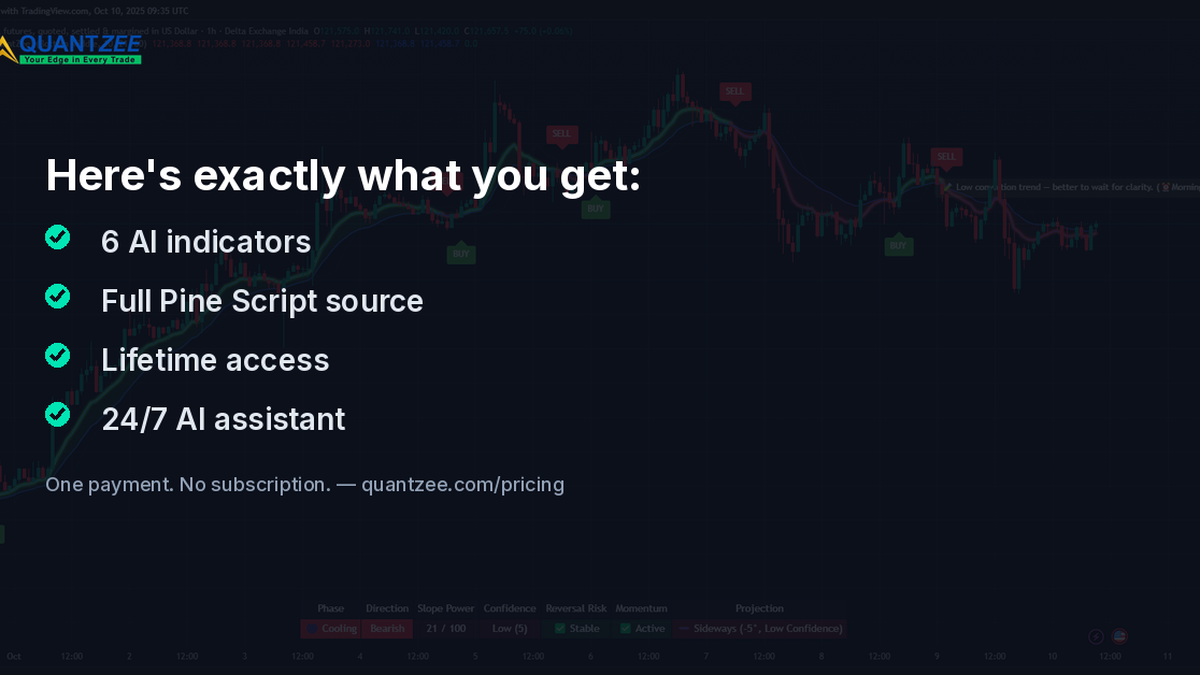
Most SEO case studies on agency blogs are written about local businesses — a clinic, a showroom, a law firm. This one is different. The client is a SaaS product, not a local business, and the product itself is a technical one: a bundle of TradingView indicators sold as a single lifetime purchase. We're writing about this engagement because the problems were different from the ones we usually solve, and because the client is one we can name without breaking confidentiality — Quantzee, which sells six Pine Script indicators (SuperTrend Pro+, AI TrendPulse, AI Adaptive Quant Toolkit, SMC Toolkit Pro, MACD Pro+ and Adaptive AI Oscillation Engine) to retail traders across stocks, crypto, forex and indices.
When we first audited the site, it scored 52 out of 100 on our internal SEO checklist. That number on its own doesn't tell you much, so here's what was actually missing: inconsistent page titles with no character-length discipline, meta descriptions that were either empty or far too long to display in a SERP snippet, no Open Graph or Twitter Card markup on most pages, and no structured data at all beyond the basics Astro ships by default. For a product site where the entire pitch is "these are real, working indicators, not a black box," the absence of trust signals in the markup was working against the sales copy, not just the search ranking.
A SaaS selling a technical product to a global audience also has a positioning trap that a local business never faces: nothing on the site could read as India-specific or as a signals service that trades for the buyer. Quantzee sells the indicator source code as a one-time purchase, not a subscription, and not advice. Every title, description and piece of schema we touched had to hold that line.
The first pass was mechanical, across all of the site's pages at the time:
fetchpriority="high", since the largest image on a product landing page is almost always the Largest Contentful Paint element Core Web Vitals scores against.noindex and filtered out of the sitemap — account and billing pages have no business ranking, and leaving them indexable was diluting crawl budget away from pages that should rank.lastmod values per section, and robots.txt updated to disallow the billing paths explicitly.Once the mechanical layer was fixed, we went back through the existing 20 blog posts the client already had live and found a specific, recurring problem: several of them linked to indicator URLs that had since changed slugs, so a reader clicking through from an old post landed on a 404. We fixed every stale link, and added "Explore Indicators" and "Related Articles" blocks to all 20 posts so a reader arriving from search had somewhere relevant to go next instead of a dead end. That work moved the overall score from 52 to roughly 82–88 out of 100 on our internal scale.
A technical fix-up gets you a clean site. It does not get you rankings on its own, and Quantzee's case made that obvious fast. A few months after the initial overhaul, we pulled Search Console data and found a specific, fixable gap: a cluster of keywords sitting at positions 8 through 14 — close enough to page one to matter, far enough to get almost zero clicks. Terms like "3commas alternative" were pulling hundreds of impressions and converting almost none of them into clicks, because the pages ranking for them didn't actually answer the question the query implied. The fix wasn't a new page. It was going back into the existing page and adding the H2s and FAQ sections that directly addressed what the searcher was actually asking, rather than the generic product copy that was there before.
We also found something less obvious: Google's own indexing-count API was reporting 0 indexed URLs out of the entire sitemap. Taken at face value, that would have been an emergency. Cross-checked against the URL Inspection API one URL at a time, 25 of 25 sampled pages came back "Submitted and indexed" — the sitemap API's indexed count is a known dead metric that Google deprecated without updating the number it returns. Reporting that 0 to a client as a crisis would have been wrong, and chasing a content fix for a problem that didn't exist would have wasted a sprint.
Part of the ongoing work has been building out dedicated pages comparing Quantzee against named competitor products — the kind of "{brand} review" and "{brand} alternative" pages that retail traders actually search for before buying an indicator. We tested two title formats against each other using the site's own Search Console data over a 90-day window, and "{Brand} Review" pages beat "{Brand} Alternative" pages on click-through rate — 1.49% versus 1.26% — so that became the locked format going forward, with the brand name first, one verifiable number from the competitor's real pricing, and the title always ending in a question. We also caught two of Quantzee's own pages cannibalising the same search term — /pine-script-alternative/ and /pineify-alternative/ were both chasing the same generic query with almost no clicks between them — and resolved it by giving each page a clearly different job: one owns the generic term, the other owns the named-competitor brand query.
None of this touches the underlying products or the AI positioning in the copy — Quantzee is explicit that these are non-repainting, adaptive signal tools sold as source code the buyer can read, not a black-box subscription, and the one-time lifetime pricing model on the site reflects that directly: a single purchase instead of a recurring plan, which is also why none of our SEO copy for the product pages was ever allowed to describe it as a subscription or an annual plan.
SEO for a product like this isn't only technical fixes and schema. Quantzee's own blog is where a lot of the keyword and content strategy actually plays out — indicator explainers, comparison pieces and trading-education posts that target the long-tail questions a retail trader types into Google before they're ready to buy anything. Cross-linking those posts to the right product pages, keeping the FAQ sections aligned to what the Search Console data showed people were actually asking, and making sure AI crawlers like GPTBot, ClaudeBot and PerplexityBot could all reach and read that content without being blocked in robots.txt, was as much a part of the engagement as the meta tag work.
To keep this case study honest, here is what Google Search Console actually reports for quantzee.com today, pulled directly from the API rather than estimated. These numbers reflect the account's current overall search performance across the full ~16.5-month history Search Console exposes (13 June 2025 to 26 October 2026) compared against the latest fully-completed calendar month, September 2026. They describe where the account stands now, not a claim that every point of the gain below came from any single fix described above — SEO compounds, and a lot of other work (content, backlinks, product changes) happened in that window too.
Every number above came straight from the Search Console API for the quantzee.com property, with no rounding beyond what's shown. We're publishing it here the same way we'd want a client to see it: as a live account snapshot, not a highlight reel.
The single biggest lesson from this engagement is that a technical SEO fix and a content fix solve different problems, and a site can fail at either one independently of the other. Quantzee's technical layer was genuinely broken when we started — no amount of good blog content would have fixed missing schema or a 404'd internal link. But once that layer was clean, the remaining gains came from going back into Search Console data on a regular cadence and fixing the specific pages sitting just short of page one, not from writing more content in general. For a technical product sold to a global, skeptical audience, the trust signals in the markup and the accuracy of every claim in the copy matter as much as the keyword targeting itself.
FAQs
Fill out the form or call us — let’s find where your next growth comes from.
9659 634 634 [email protected]Free Growth Audit
See exactly where your traffic, leads and ROAS are leaking — and how to fix it. A senior Nurotech strategist reviews your website, SEO and ads. Free, no obligation.
No spam. We reply within 1 business day.