Digital Marketing

Facebook and Instagram ads are the most powerful paid growth lever available to small businesses in India today — and also the most commonly misused. Small business owners either avoid them because they do not know where to start, or they start, burn ₹10,000–₹20,000 with no results, and conclude that "Meta Ads don't work." Both outcomes come from the same root cause: running ads without a system.
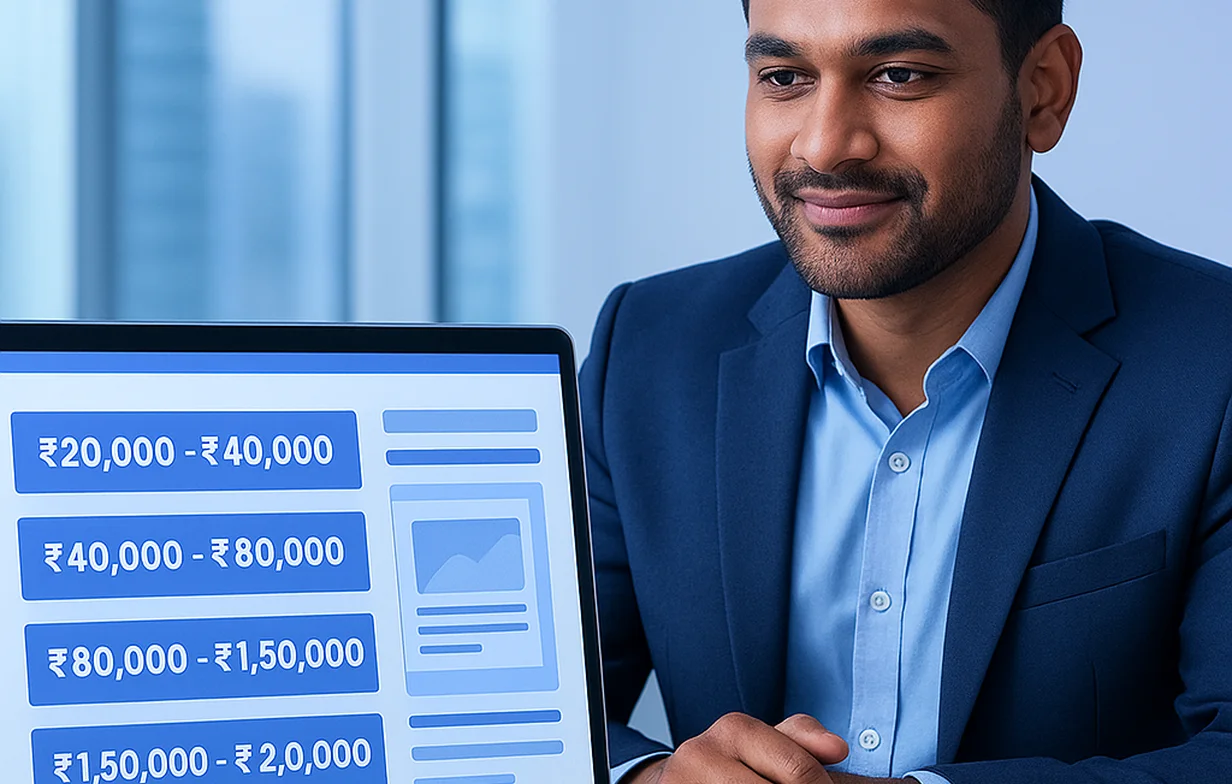
This guide builds the system. Step by step. Starting from zero, with an honest breakdown of what to expect at each budget tier from ₹5,000/month to ₹1,00,000/month. We also include an India-specific festival marketing calendar — because for small businesses here, running a Diwali campaign without preparation is leaving money on the table.
India has over 500 million Facebook and Instagram users combined. Monthly active Facebook users in India: approximately 340 million. Instagram: approximately 250 million (significant overlap). These are not niche platforms — for most Indian consumer categories, your customers are here.
The specific advantages for small businesses:
1. Hyper-local targeting. You can run ads within a 5–20 km radius of your business location. A coaching institute in Rajouri Garden, a boutique bakery in Indiranagar, or a dental clinic in Baner can reach ONLY the neighbourhoods where their likely customers live. No other advertising medium gives you this precision at this cost.
2. Detailed interest and demographic targeting. Meta knows more about its users' interests, life events, and income signals than almost any other platform. You can target first-time homebuyers, parents of children aged 3–12, people with an interest in photography who earn above a certain threshold, or users who have recently moved to a new city.
3. Remarketing. Users who visited your website, engaged with your Instagram profile, or watched more than 25% of one of your videos can be shown a second, more specific ad. This is the mechanism that turns a cold audience into a buying customer.
4. WhatsApp integration. Indian businesses increasingly use Meta's "Click to WhatsApp" ad objective — the ad takes users directly to a WhatsApp conversation with your business. For service businesses where the transaction happens via conversation, this is extremely effective. this guide covers how to automate the WhatsApp side once the lead arrives.
1. Set up Meta Business Suite (business.facebook.com). This is the central hub for your ad account, Facebook Page, and Instagram profile. Do NOT run ads from a personal account — the targeting options are limited and the account lacks proper business controls.
2. Create a Business Manager. This is different from your personal Facebook profile. It is the business entity that owns your ad account, your Page, and your Pixel. Create one at business.facebook.com/overview.
3. Install the Meta Pixel on your website. The Pixel is a small code snippet that tracks what users do on your website after clicking your ad. Without it, you cannot optimise for conversions — you are flying blind. Installation: go to Events Manager in Business Suite → Pixels → Create Pixel → copy the code → paste into the <head> of your website. Or install it via a plugin if you are on WordPress.
4. Set up the Meta Conversions API (CAPI). Since Apple's iOS 14.5 update (2021), browser-based tracking (Pixel alone) misses roughly 20–40% of conversion events. The Conversions API sends data server-side directly from your server to Meta. If you are on Shopify, this is now automatic. On WordPress/WooCommerce, use the official Meta for WooCommerce plugin. On custom builds, your developer needs to implement the CAPI integration.
5. Verify your Facebook Page has consistent NAP (Name, Address, Phone). Meta uses your Page as a quality signal. An incomplete page — no profile photo, no cover image, no contact details — lowers your ad quality score and increases costs.
6. Check DPDP Act compliance on your landing pages. India's Digital Personal Data Protection (DPDP) Act 2023 requires that you have a clear privacy policy, a stated purpose for data collection, and a mechanism for users to request data deletion. If you are collecting leads via Meta Lead Ads or your website, this is non-negotiable.
Meta offers several campaign objectives. For small businesses in India, you will most commonly use these four:
Awareness — Use when: launching a new business or product, entering a new neighbourhood, building brand recognition. KPI: reach, cost per 1,000 impressions (CPM). Budget sensitivity: can work at ₹5,000–₹10,000/month.
Traffic — Use when: you want people to visit a specific landing page, a product page, or a blog post. KPI: link clicks, cost per click (CPC), landing page view rate. Risk: Meta optimises for clicks, not for what happens after the click — use this only if your conversion tracking is set up.
Leads (Lead Generation) — Use when: you sell a service (coaching, real estate, legal, healthcare, agency services) and want people to submit their contact details without leaving Facebook/Instagram. KPI: cost per lead (CPL). The lead form fills automatically with the user's Facebook profile data. Advantage: extremely low friction. Disadvantage: lead quality can be lower because the barrier is so small.
Sales (Conversions) — Use when: you have an e-commerce store, a checkout flow, or a high-intent action on your website. Requires the Pixel to be installed and conversion events configured. KPI: cost per purchase, ROAS (return on ad spend). Requires a minimum of 50 conversion events per ad set per week for Meta's algorithm to optimise properly — this means you need volume before this objective works well.
Before opening Ads Manager, write down: - What specific action do you want people to take? (Call, fill a form, buy, visit the store) - Who is your ideal customer? (Age range, gender, city/neighbourhood, interests, income level, life stage) - What is the single most compelling reason they should choose you? (Your offer) - What does ₹1 in revenue require you to spend? (Know your unit economics before you spend)
In Business Manager, go to Business Settings → Accounts → Ad Accounts → Add → Create a New Ad Account. Set the currency to INR. Set the timezone to India (Kolkata). Add your payment method — Indian debit cards, credit cards (Visa/Mastercard/Amex), and Indian bank accounts via direct debit work. UPI is not supported for recurring billing.
Important: Meta bills in USD for Indian accounts. The conversion happens at the daily exchange rate. Budget for INR/USD fluctuation in your cost projections.
In Ads Manager (adsmanager.facebook.com) → Create. Select your objective. Name the campaign clearly: "Nurotech_LeadGen_Delhi_July2026" is more useful than "Campaign 1" when you have 15 campaigns running.
Advantage Campaign Budget (formerly known as Campaign Budget Optimisation/CBO): ON for most campaigns. Let Meta distribute budget across ad sets based on performance rather than setting it per ad set manually.
Audience targeting for Indian small businesses:
Location: Use "People who live in this location" (not "everyone in this location" — avoid tourists/passers-through for most service businesses). Radius: 5–20 km for hyper-local; city-level for D2C. For pan-India campaigns, start with top-6 metros and add tier-2 cities only when you have proof the offer converts.
Age/Gender: Be realistic, not aspirational. Your actual customers probably have a tighter age range than you think. If 80% of your past customers are 28–45, target 25–48 (add a small buffer) not 18–65.
Interests: Layer 2–3 interest categories. Avoid going too narrow (under 200,000 audience size in India = too small for the algorithm to learn) or too broad (over 5 million in a single ad set = creative and audience mismatch risk). Target interests relevant to your service, not just your demographic.
Placements: Use Advantage+ Placements (Meta auto-selects across Facebook, Instagram, Audience Network). If you are running creative specifically designed for Instagram Reels (vertical video 9:16 ratio), manually exclude other placements for that ad set.
Budget: See the Budget Tier section below for specific numbers.
The structure of a high-performing Facebook ad:
Creative formats that work in India:
What this buys: Limited testing. You can run one or two campaigns, generate early learning, and get a rough CPL indication.
Reality: At this level, you will not exit Meta's "Learning Phase" on most ad sets (Meta needs 50 conversions per week to properly optimise). Your results will be inconsistent. This is appropriate for: brand new businesses building their first audience, testing an offer concept before committing more budget, or local businesses with very small geographic targets.
Typical outcomes (service businesses, Delhi NCR): - Impressions: 30,000–80,000/month - Leads: 5–25 (depending on CPL category) - CPL: ₹300–₹2,000
What NOT to do at this level: Run conversion-objective campaigns before you have enough Pixel data. Stick to traffic or lead generation objectives.
What this buys: The beginning of meaningful optimisation. With consistent CPL data across 30–60 days, you can identify which audience segments and creatives perform, and double down.
Typical outcomes (service businesses): - Impressions: 80,000–3,00,000/month - Leads: 20–150 (depending on CPL category) - CPL: ₹250–₹1,200 (improving with optimisation)
Recommended structure: - 2–3 ad sets per campaign (3–4 audience variants) - 2–3 creative variants per ad set - Weekly optimisation: pause creatives below average CTR, expand budget on best-performing audiences by 20%
Key milestone: By month 3 at this budget level, you should have enough data to identify your best-performing audience and creative combination. Double your budget only on what is working.
What this buys: The ability to run a full-funnel strategy — awareness at the top, retargeting in the middle, conversion at the bottom.
Recommended split for service businesses: - 60% on prospecting (new audiences — interest, lookalike from past leads) - 30% on retargeting (website visitors, video viewers, page engagers in the last 30 days) - 10% on lookalike audiences built from your best customers
Typical outcomes (service businesses with established creative): - Impressions: 3,00,000–8,00,000/month - Leads: 100–500/month - CPL: ₹150–₹600 (with optimised creative and audiences)
At this budget level, professional agency management becomes economically sensible. A 15% management fee (₹7,500–₹15,000/month) is easily justified if the agency reduces your CPL by 20–30%. our performance marketing page covers Nurotech's approach to managing accounts at this scale.
Indian consumer spending patterns are heavily influenced by the festival calendar. Small businesses that plan their Meta Ads campaigns around these periods consistently outperform those that treat every month the same.
July: - No major festivals. Use this as a testing/optimisation month — lower CPMs mean cheaper audience building. - Guru Purnima (mid-July): relevant for education, coaching, spiritual services. - Start building your Raksha Bandhan creative inventory.
August: - Raksha Bandhan (9 August): gifts, sweets, fashion, jewellery. Start ads 10–12 days before. - Independence Day (15 August): patriotic campaigns, offers. Competitive CPMs — ensure strong creative. - Janmashtami (late August): food, sweets, celebration categories.
September: - Ganesh Chaturthi (September/October, varies): Major in Maharashtra, Karnataka, AP. If you serve these markets, plan aggressively. Decorations, sweets, catering, gifting. - Navratri begins (late September some years): Fashion, jewellery, dandiya event promotions.
October–November (Navratri to Diwali): This is the single highest-spend period for most Indian consumer businesses. CPMs on Meta increase 40–80% during this window — but so does purchase intent.
Budget recommendation for Diwali period: 2X–3X your normal monthly budget. Allocate the increase across: awareness (3 weeks out), consideration and lead capture (2 weeks out), retargeting and conversion push (1 week out and the 3 days before Diwali itself).
November: - Post-Diwali sales: heavily advertised by large brands. Smaller businesses can compete on personalisation and local relationships. - Guru Nanak Jayanti (November): relevant for Punjab, Haryana, Delhi markets. - Thanksgiving/Black Friday/Cyber Monday: increasingly relevant for D2C and tech-adjacent Indian brands. Urban, metro, 18–35 demographic.
December: - Christmas (25 December): food, gifting, hospitality, travel - New Year's Eve campaigns: hospitality, events, fashion, fitness ("new year, new me" hooks for gyms, coaching, health) - Year-end clearance: strong for e-commerce, fashion, home goods
January: - Makar Sankranti/Pongal/Lohri (mid-January): varies by region. Sweets, food, kites (Sankranti), harvest categories. - Republic Day (26 January): patriotic campaigns, offers.
February: - Valentine's Day (14 February): gifting, fashion, restaurants, travel, experiences. CPMs spike for 18–35 demographic. Start 7–10 days before.
March: - Holi (varies, typically March): colours, fashion (clothes buyers in this period), food, celebration - Women's Day (8 March): fashion, beauty, wellness, empowerment campaigns
Rule: Add 2 weeks to every festival campaign start date. "We will start 5 days before Diwali" is a recipe for spending more on CPMs and reaching fewer people. Meta's algorithm needs time to learn and optimise. Starting 3 weeks before means your cost per lead is 20–40% lower by the time the festival peak hits.
In Hindi, Tamil, Telugu, Bengali, Kannada, Marathi. If your target audience is not predominantly English-language, using their language in ad copy dramatically increases engagement and CTR. Meta allows you to target by language AND location simultaneously.
Use real photos, not stock images. Indian audiences on Meta are banner-blind to generic stock photography. A real photo of your shop, your team, or a customer using your product — even imperfectly shot on a phone — consistently outperforms polished stock imagery. This is one of the most consistent findings across categories and budgets.
Price in the ad copy. Indian buyers are price-conscious, and showing the price filters your audience. "Starting at ₹999" in the headline attracts the right buyers and repels those outside your range — both of which are good. Higher CPL with better lead quality is almost always more profitable than lower CPL with poor quality.
Social proof in the creative. "1,200 happy families served" or "4.8 stars on Google from 340+ reviews" converts significantly better than "Best in Delhi." Specific numbers > superlatives, every time.
Mistake 1: Running ads without a landing page. "Send people to my homepage" = money left on the table. Your homepage serves many purposes. A landing page serves one: convert the specific visitor who clicked a specific ad. Even a simple landing page with one headline, one image, one form, and one CTA outperforms a homepage by 50–200% for lead generation.
Mistake 2: Stopping too early. We have seen business owners pause campaigns after 7 days because the first week underperformed. Meta's algorithm needs at least 50 conversion events per week to exit the learning phase. Pausing early locks in bad performance data. Commit to 30 days before making major decisions.
Mistake 3: Running one creative for months. Creative fatigue is real. When the same people see the same ad 8–10 times without converting, CTR drops and CPL rises. Refresh creative every 4–6 weeks with a new image, new headline, or new hook.
Mistake 4: Ignoring mobile optimisation. 85%+ of Meta ad clicks in India happen on mobile. If your landing page loads slowly (over 3 seconds) or is not mobile-responsive, you are converting a tiny fraction of your traffic. Check your mobile page speed at pagespeed.web.dev.
Mistake 5: Not using the WhatsApp flow. For service businesses in India, "Click to WhatsApp" ads — where the ad sends users directly into a WhatsApp conversation — consistently deliver higher lead quality than lead forms, because the user takes a higher-intent action. The trade-off is a higher CPL (conversational friction), but the close rate is typically 2–3X higher. this guide covers how to automate the WhatsApp conversation so no lead goes unanswered.
Facebook and Instagram ads work for Indian small businesses. They do not work automatically. The difference between campaigns that generate real growth and campaigns that burn budget is systematic setup, disciplined creative testing, consistent optimisation, and budget aligned to the festival calendar.
Start with the basics: one campaign objective, one audience segment, two or three creative variants, 30 days of data before major decisions. Add the Pixel and Conversions API before you spend your first rupee. Plan your biggest campaign investment for the Navratri-to-Diwali window.
If you want help setting up or auditing your current Meta Ads account, contact us — Nurotech offers a free 30-minute strategy session with no obligation.
Sources: - Meta for Business India — Advertising Resources: https://www.facebook.com/business/tools/ads-manager - TRAI (Telecom Regulatory Authority of India) — Internet in India Report 2025: https://www.trai.gov.in - MeitY — Digital Personal Data Protection Act 2023: https://www.meity.gov.in/data-protection-framework
FAQs
Fill out the form or call us — let’s find where your next growth comes from.
9659 634 634 [email protected]Free Growth Audit
See exactly where your traffic, leads and ROAS are leaking — and how to fix it. A senior Nurotech strategist reviews your website, SEO and ads. Free, no obligation.
No spam. We reply within 1 business day.